Fire-roasted tomato and tortellini soup

I’m still recovering from foot surgery. After an hour (at most) on my feet I’m achy and need to sit for a while with my feet up. What does this have to do with cooking, you ask?

Tom’s been doing the grocery shopping. This is not a hardship for him; he always does the bulk of the grocery shopping. But I’m the one who keeps us supplied with the harder-to-find items (hard to find in a small Midwestern town, at least).  That involves driving 45 minutes to an enormous store with a fantastic selection. It takes a good hour to get around the store, more than I can handle at this point.

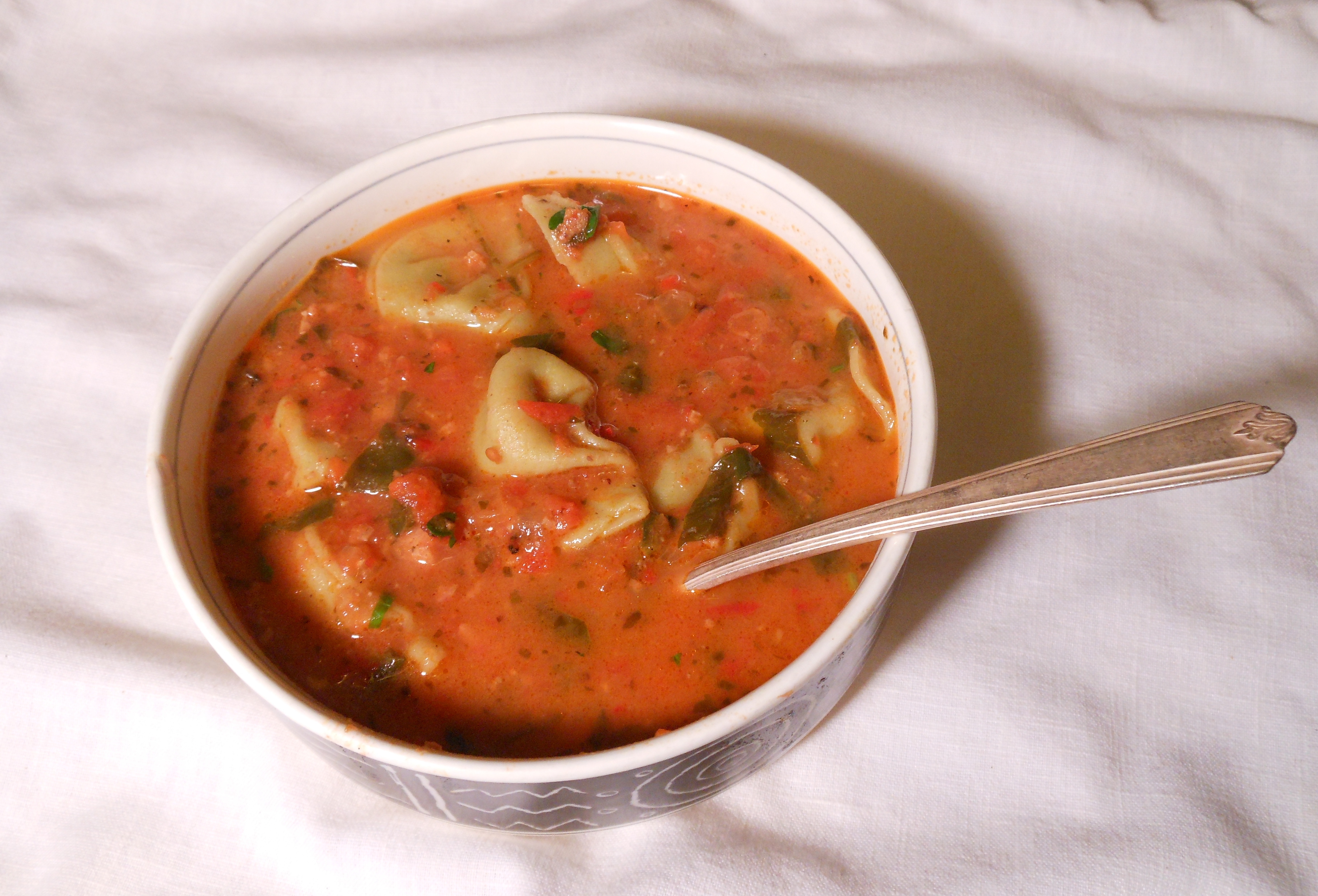
Meanwhile, I’m relying on my pantry. This soup combines the last of our favorite items: chicken andouille, fire-roasted tomatoes, roasted red peppers, and fresh tortellini (from my stash in the freezer).  The soup goes together quickly but tastes like it’s simmered for hours.

I love the color contrast of spinach tortellini floating in the intensely red broth. Ribbons of spinach accent that contrast. The sweet roasted peppers balance the acidity of the roasted tomatoes, and the tortellini make it a meal. A small handful of fresh basil, chopped and tossed in at the last minute, would be perfect, but parsley also provides that herbal goodness.

Use whatever stuffed pasta (tortellini, tortoloni, ravioli) you like. I’ve made this soup without the spinach, stirred a few tablespoons of heavy cream in at the last minute, and added a few shots of hot sauce for vinegary heat. You can certainly leave the sausage out and use vegetable stock for a vegetarian option.

Tortellini Soup with Fire-Roasted Tomatoes
serves 4-6

1/2 cup finely chopped spicy sausage (I used chicken andouille)
2 tbs. olive oil
1 medium onion, chopped
2 cloves garlic, minced
1 stalk celery, chopped
1 fresno chile, minced, optional
salt and pepper to taste
1/4 cup pesto, or 2 tsp. dried basil
1 cup chopped roasted peppers (1 large roasted pepper), chopped
16 oz. chopped fire-roasted tomatoes
6 cups chicken stock, about
8 oz. fresh or frozen tortellini
2 cups thinly sliced fresh spinach
chopped fresh basil or parsley, to garnish

In a large stockpot over medium-high heat, brown the sausage in the oil. When the sausage bits have some lovely toasty bits, add the onion, garlic, celery, and chile if using. Cook for about 5 minutes, stirring frequently, until the vegetables are softened. Season lightly with salt and pepper.

Stir in the pesto, roasted red peppers, tomatoes, and stock. Once the soup reaches a boil, reduce the heat to medium-low and simmer, covered, for about 30 minutes. Taste and adjust the seasoning. At this point you can purée part of the soup for a thicker texture.

Add the tortellini and simmer for another 10 to 15 minutes until the tortellini is tender. Stir in the spinach in the last 5 minutes of cooking.

Posted in appetizers, main courses, soups | Tagged , , , , , , , , | 10 Comments

Butternut squash with andouille and creamy polenta

Pie. That was the only way my mom ever used a butternut squash. Her squash pie is like pumpkin pie, only much better, in my completely unbiased opinion. I’ll post that recipe in the future, when I finally learn how to make a piecrust that doesn’t resemble cardboard.

Way back in the 1990s, on an episode of In Julia’s Kitchen with Master Chefs, one of her guest chefs (whose name escapes me–so sorry!) sautéed cubes of squash with shallots and garlic, of all things, for a savory side dish. What a revelation.

Since then, I’ve roasted and sautéed butternut squash in various savory ways. It holds up well to garlic, chilies, and thyme. When puréed it makes a rich and creamy soup.

This dish was an exercise in pantry- (and freezer-)clearing. I needed to make dinner, but nothing was thawed and the veggie drawer’s contents  were uncharacteristically sparse. I always have chicken andouille in the freezer and cornmeal in the fridge.

Spicy andouille is a lovely foil for the sweet squash. When cooked together with a little liquid, the result is a richly satisfying stew that’s filling without being heavy. When you use chicken or turkey andouille, it’s a healthy dinner to boot.

I’ve made this twice in the last few weeks, once with red bell peppers added, and once without. I’ll try it with some kale, or maybe with chickpeas. A splash of white wine at the beginning, or sherry at the end, would contribute a subtle hit of acid, but it’s not necessary.

We’re unabashed carb-lovers in this house, so the idea of serving a stew without starch is incomprehensible. I contemplated serving this with popovers, but decided on polenta. For a creamy texture, use a 4:1 liquid to cornmeal ratio, and use milk as at least half your liquid. You could certainly use all milk, but chicken stock adds flavor, and a little water lightens the texture and lowers the calorie count. Montery jack enhances the velvety texture but is mild enough not to compete with the flavors of the stew.

You can make the polenta hours (or a day) ahead, pat it into a disc about an inch thick, and let it cool. Then cut it into shapes and sauté them in a hot pan glazed with oil until browned and crisp.

[Delicious dish, lousy photos; I apologize. Make it anyway. This photo, above, is a better indication of how creamy the polenta is.]

Butternut Squash with Andouille and Creamy Polenta
serves 4

for the squash:
1 small butternut squash
2 tbs. oil, divided
3 chicken andouille sausages, sliced
1 small onion, chopped
1 stalk celery, finely chopped
2 cloves garlic, minced
1 small red chile (such as Fresno), minced, optional
2 1/2 cups chicken stock, about
1 tbs. honey
salt and pepper to taste

for the polenta:
1/2 cup chicken stock
1/2 cup water
1 cup whole or 2% milk
1 tsp. salt
1/2 cup cornmeal
3/4 cup grated Monterey jack cheese
1 tbs. butter

Peel the squash,  then cut in half. Scoop out the seeds and cut the flesh into small cubes 3/4  to 1 inch. You’ll need about 4 cups.

Sauté the sausage in 1 tbs. of the oil in a large skillet over medium-high heat until browned on both sides. Set aside. To the same pan add the remaining tbs. oil. Stir in the onion, garlic, celery, and chile (if using) and cook for 3 to 5 minutes until softened. Add the squash, give a good stir, and stir in about half the stock, all the honey, and a few healthy pinches of salt and pepper. Lower the heat to medium, cover the pan, and cook for about 10 minutes.

Meanwhile, pour the 1/2 cup stock, 1/2 cup water, and the milk in a medium saucepan over medium-high heat. Keep an eye on it; you want it to reach a decent simmer, but not a full boil.

Taste the squash and add salt if necessary. Add most of the remaining stock, stir in the sausage, and cook, uncovered, for another 15-20 minutes, stirring now and  then, until the squash is very tender and the liquid is reduced and thickened. I mashed a few cubes of the squash with a fork to speed up the thickening.

While the squash cooks, slowly whisk the cornmeal into the simmering liquids. When it’s all added, whisk vigorously until the mixture is thick and smooth. Whisk in the salt. Reduce the heat to medium-low. Switch to a spoon (preferably wooden) and cook for about 15 minutes, stirring frequently.

Meanwhile, stir the squash every now and then, and add more stock if it’s too dry.

Taste the polenta. It should be smooth and not gritty. When it’s at the proper texture, stir in the cheese a handful at a time, then add the butter.

Spoon the polenta into bowls, and top with the squash and sausage.

Posted in main courses, meat, poultry,and fish | 3 Comments

Apple-carrot cake

I’m officially endorsing cake for breakfast. Not all cakes, of course. If you’re snarfing down a slice of triple-layer chocolate cake at 9 am, I don’t want to hear about it.

This cake is so loaded with carrots and apples that there’s barely enough batter to hold the healthy ingredients together. The resulting confection is as flavorful as carrot cake, but lighter and with much less oil. The cooked carrot shreds are just slightly chewy, while the apples are tender. Brown sugar lends a caramel undertone and the spices add warmth.

My mom makes this cake with Granny Smith apples, no carrots, and with 1 1/4 cups white sugar. My friend Leona makes it with grated apples, not chunks, and bakes it in a larger pan for a denser, more bar-like treat. I usually add a few handfuls of chopped walnuts or pecans, but I simply forgot this time. Sometimes I add raisins or dried cherries. I’m thinking some shredded coconut would be fantastic — next time I’ll try that.

I peel the apples because I find cooked apple skins to be tough, but if you don’t mind them, feel free to leave them on. I used locally grown Gala apples because that’s what I had; the cake’s equally good with McIntosh or my mom’s favorite Granny Smith. The combination of cinnamon, nutmeg and ginger is warm and rich, but you can certainly just use cinnamon if that’s what you have on hand.

The cake’s complete as is, unadorned. It also benefits from a light sprinkling of cinnamon sugar for a crackly finish. Mom whisks together a little powdered sugar with some lemon juice and honey to make a thin glaze. Tom requested cream cheese frosting, but that would defeat my goal of a healthy treat. (In the interest of full disclosure, I have eaten it with a scoop of vanilla ice cream on the side.)

Apple-Carrot Snack Cake
makes one 9-inch cake

1 cup grated carrots (about 2 medium)
2 cups peeled, cored, chopped apples
1/2 cup white sugar
1/2 cup packed brown sugar
2 cups flour
2 tsp. baking soda
1 tsp. salt
1 tsp. cinnamon
1/2 tsp. ground ginger
1/4 tsp. nutmeg (freshly grated if possible)
2 eggs
1/2 cup oil (vegetable or canola)
2 tsp. vanilla

Grease and flour a 9-inch cake pan (round or square). Heat the oven to 350 degrees F.

Mix carrots, apples, and the sugars; set aside. In a small bowl, stir together the flour, baking soda, salt, and spices. In a large bowl, whisk together the eggs, oil, and vanilla.

Stir in about a third of the dry ingredients just until barely blended. Stir in half the carrot-apple mixture, then another third of  the dry ingredients, then the rest of the carrot-apple mixture, and finally the last of the dry ingredients.

Scrape the batter into the prepared pan and bake for about 50 minutes until a skewer inserted in the middle comes out with just damp crumbs clinging, not batter. This moist cake is best eaten within a few days, but it’s too tasty to last longer than that.

Posted in baked goods, sweet stuff | Tagged , , , , , , | 2 Comments

Braised chicken and bell peppers

To misquote my sister’s favorite TV chef Ina Garten, how pretty is that? Red bell peppers are one of my top three favorite vegetables. They’re sweet without being sugary, delicious raw and cooked into oblivion, or anywhere in between, and they’re so darned gorgeous.

Chicken thighs are flavorful, inexpensive, and really shine when they’ve had a long, slow braise. I used skinless, boneless thighs, but you can leave the skin and/or bones on for depth of flavor. In that case, you may want to defat the sauce.

Scoop out the chicken and veg with a slotted spoon and set them aside in a covered bowl to keep warm. Pour the sauce into a small bowl (preferably metal; it’ll conduct the heat away faster)  and set that in a sink or large bowl of ice water, making sure that the water doesn’t spill into the sauce. Leave it alone for 30 minutes or so. The fat will rise to the top, and you can skim it off.

If you want to go the extra fat-free step (healthier, but not necessary), you can put the cooled sauce in the freezer for 20 minutes, which should solidify the fat and make it easier to remove. I puréed some of the peppers and onions into the sauce, but you can strain them out and serve them on the side if you prefer.

If you’re in a time crunch, a fat separator is your friend. This clever gadget looks like a measuring cup (usually 16-32 oz.) with the spout originating at the base of the cup, rather than the top. Pour your hot sauce in the cup and let it sit for about 15 minutes. The fat will rise to the top. When you pour (slowly and carefully) the sauce back into your pan, the defatted liquid on the bottom comes out first. Just stop pouring when you reach the fatty layer.

I like to de-fat the liquid, then purée the onions, garlic and a few of the peppers into the sauce. This accomplishes several goals at once: It thickens the sauce without extra fat, it adds layers of flavor and rich color, and it adds nutrition to the sauce, so that certain family members (you know who you are!) end up eating more veg than they might choose to on their own. I’m only thinking of their health.

I served these with  quartered new potatoes boiled in salty water with a smashed clove of garlic, then tossed with chives and a small dab of butter. The dish is equally suited to these taters, egg noodles, brown rice (or grain of your choice), or just a hunk of good bread to mop up the sauce.

Braised Chicken Thighs and Red Peppers
serves 4

2 tbs. olive oil, divided
8 chicken thighs
salt and pepper
1 medium onion, chopped
1 large red bell pepper, chopped
1 large clove garlic, left whole
1 tsp. dried thyme or 1 tbs. fresh
1/2 cup white wine
2 cups chicken stock
1 tbs. butter, softened, optional
1 tbs. flour, optional

Warm 1 tbs. oil over medium-high heat in a large skillet (preferably cast iron) with a lid. Sprinkle the chicken liberally with salt and pepper. Add skin-side down to the hot pan; cook without moving for about 5 minutes. When the chicken’s well browned it will release easily from the pan. If it’s sticking, leave it for another minute or two. Flip thighs and brown on the second side for another 3 to 5 minutes. Remove to a bowl.

Add the second tbs. oil to the pan and toss in the onion, peppers, and garlic clove. If you’re using dried thyme, add it now. Cook, stirring often, for about 5 minutes until the veg begin to soften and the lovely browned bits from the chicken are released. Add the wine and cook for 1 minute; add the stock and stir. Nestle the thighs among the veggies, cover pan, and reduce the heat to low.

Simmer, covered, for at least an hour (and up to 90 minutes), until the onions and peppers are meltingly tender and the chicken’s falling apart. Remove the chicken and peppers to a serving platter. Peel the garlic clove, if necessary, and mash into the sauce. Raise heat to high and boil fiercely for a minute or two to concentrate the sauce.

If you want a thicker sauce, don’t boil it just yet. Mash the butter and flour together in a small bowl (this is a beurre manié).  Whisk the beurre manié into the sauce, raise the heat to medium-high, and cook, stirring, until the sauce has thickened. If it’s too thick, add a little more stock. If you want a smooth sauce, purée it with a stick blender, but it’s not necessary. Pour the sauce over the chicken (or serve it on the side).

Posted in main courses, meat, poultry,and fish | Tagged , , , , , , | Leave a comment

Apologies for my absence

I’m so sorry I’ve been gone so long. I promise I’ll get back to food posts soon, but it’s been a while since I’ve hit the kitchen in any significant way.

I’ve mentioned that I traveled with my sisters to Portland, Oregon in early September. In preparation for that trip, I went shopping for a comfortable pair of walking shoes. I couldn’t find a pair that was comfortable to try on, not even athletic shoes. I made an appointment with our orthopedic surgeon.

He told me that yes indeed, I had bunions and my other bones were starting to shift. If I had surgery soon, I could have both feet fixed at once. I live in Wisconsin; we specialize in large quantities of snow over many months. So just over two weeks ago, I had my bunions removed, my metatarsals rearranged, and the whole shebang held together with absorbable pins. And I walked out of surgery on crutches the same afternoon.

I spent the vast majority of the first week on the couch with my feet on a stack of cushions, eating canned soup, Thomas’ fantastic chili, and some darned tasty Italian hot beef that our friends Laurie and Tom very kindly sent over.

After a week, and despite all the delicious food, I missed cooking. Following a tip from my sister Jul, who’d had bunion surgery a year before, I had Thomas set a bar stool next to the stove and gather a few items from the pantry. Then, with my feet propped up on an open kitchen drawer, I made a big batch of pasta with chickpeas and spinach, substituting orzo for the soba noodles.

Since then, I’ve been easing back onto my feet and into the kitchen. I promise to get back to my weekly posts. I’ll work in some cooking around the shoe shopping.

Posted in not food | Leave a comment

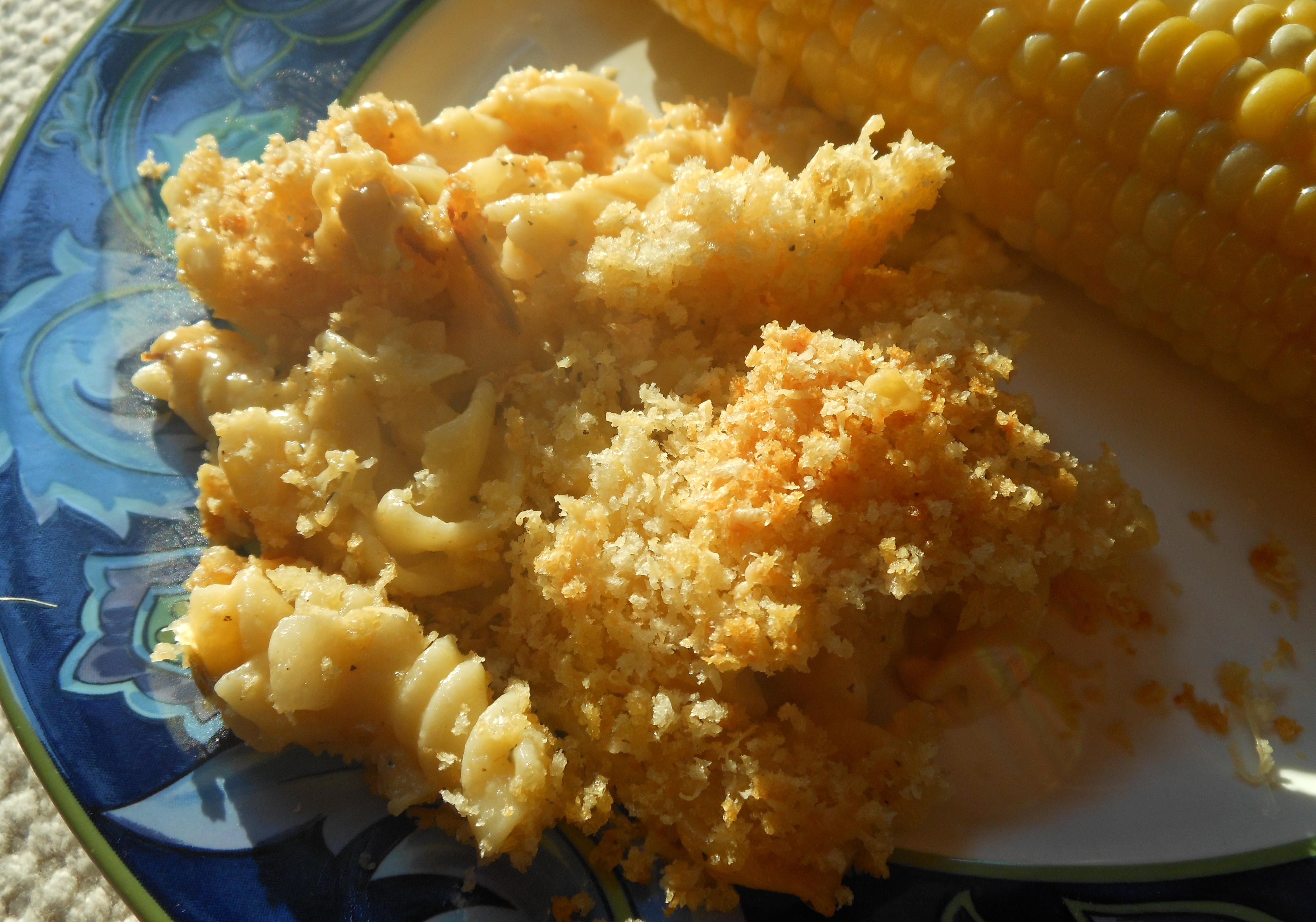
Mac & cheese with a panko crust

Today’s post will be fast and dirty, because my brother-in-law Steve requested this recipe and I leave tomorrow morning for Portland, Oregon.

We served this mac and cheese to Steve and his family a few days ago. I made a lot and took notes. This dish makes frequent appearances on our dinner table, but I plan to make it for the entire varsity soccer team later this month, so I was experimenting with quantity.

There are those who lean toward the “noodles + cheese and that’s it” style; others swear by copious amounts of cream; some even sneak in an egg yolk or two.

I belong to the mornay camp. Mornay sauce is bechamel plus cheese. Bechamel is the classic white sauce, the basis of an array of dishes. You start with melted butter with an equal amount of flour whisked in (the roux), then add warm milk. The standard formula is 1 tablespoon each of butter and flour per cup of milk; use more butter/flour (roux) for a thicker sauce, less for a thinner one.

For more flavor, I like to use roughly 2/3 whole milk to 1/3 chicken stock. (Technically, stock thickened with a roux is a velouté sauce, so my method is part velouté and part bechamel with cheese added. Just to confuse things.)

Cheddar, preferably extra-sharp cheddar, is the big cheese, so to speak. I like to add a little of a second (or even third) cheese for complexity. Monterey jack adds creaminess, parmesan contributes a sharp saltiness, and gorgonzola (just a little) adds a little something  that’s hard to place but deepens the flavor.

Whole grain pasta is the way to go, as far as I’m concerned. It has a welcome nuttiness and firm texture. If you’re not a fan use regular pasta, but think shapes, not sticks; short pasta holds up much better than spaghetti.

Panko, Japanese breadcrumbs, are neutrally flavored but fantastically crunchy. Toss them with a little oil to aid browning.

No cooking for the next week; I’ll be touring Portland, Oregon with my sisters. I can’t wait.

Mac & Cheese with a Panko Crust
serves 8

1 lb. pasta
4 cups whole milk (or 3 1/2 cups milk + 1/2 cup heavy cream)
2 cups chicken stock (or vegetable stock, for a vegetarian version)
3 tbs. butter
1/4 cup minced onion
2 cloves garlic, minced
salt and pepper
3 tbs. flour
1 tbs. mixed dried herbs, optional
3 1/2 cups grated cheddar (sharp or extra-sharp)
1 cup grated parmesan, divided
2 tbs. gorgonzola, optional
1 cup panko breadcrumbs
1 tbs. olive oil

Heat oven to 375 degrees F. Butter a 9 x 13-inch baking dish. Cook pasta in boiling salted water in a large stockpot until 1 minute short of done; it should be almost cooked through but just a little too chewy. Drain, pour back into the stockpot, and set aside.

Heat the milk and stock in the microwave until warm, not hot. In a large saucepan, melt butter over medium heat. Add the onion, garlic, and seasonings; cook for 2 minutes until the onion is softened. Add the flour and cook for a minute or two. Whisk in the warmed milk and stock. Cook, stirring often, until thickened, about 5 minutes. (This, by the way, is a bechamel sauce.) The sauce should be on the thin side; the starch from the pasta will thicken it as it bakes.

Take the sauce off heat and gradually stir in the cheddar, 1/2 cup of the parmesan, and gorgonzola if using. Taste and adjust seasoning. Pour the sauce over the drained pasta and stir to combine. Pour into the buttered baking dish.

In a small bowl, drizzle the oil over the panko. Stir with your fingers until the oil is well distributed. Season to taste with salt and pepper; stir in the parmesan. Sprinkle the panko mixture over the mac and cheese and bake for about 30 minutes until the pasta’s bubbly and the topping is browned and crisp.

Posted in main courses, pasta, rice, and grains | Tagged , , , , , , , , | 2 Comments

Garlicky zucchini noodles

I had a honkin’ big zucchini from a friend’s garden. Actually, that’s what led me to search for a new recipe, that baseball bat of a squash lording over the tiny cherry tomatoes on my kitchen counter, issuing a challenge.

I saw a version of this dish on Food52’s website, submitted by dymnyno. She called it Zuccaghetti. I kept the general technique but changed the sauce to accommodate what I had in the house.

When you salt the zucchini and let it sit, the texture changes. The strands become flexible, like cooked fettucini, yet somehow retain their crunch. I kept the sauce simple in order to focus on the lovely “noodles.” I’ll try this with some lemon zest or fresh herbs other than chives as well. Halved, seeded cherry tomatoes would also be lovely.

You’d expect that the zucchini noodles would be overly salty, but the balance is just perfect. I mixed the sauce in at the last moment, thinking that it would become watery if it sat too long — an unfounded concern, it turns out.  I had the leftovers for lunch the next day, with some leftover grilled salmon mixed in. Heaven.

Garlicky Zucchini Noodles
serves 4 as a side dish

1 large or 2 small zucchini, julienned (about 3 1/2 – 4 cups)
2 1/2 tsp. salt, divided
1/3 cup sour cream (I used low-fat)
1 small clove garlic, grated*
2 tbs. chopped chives
ground black pepper
1/4 cup grated parmesan
1 red chile, minced, optional

Sprinkle the julienned zucchini with 2 tsp. salt and toss with your fingers to mix well. Place in a colander or strainer and set aside to drain for 30 minutes.

Meanwhile, stir together the sour cream, garlic*, 1/2 tsp.  salt, chives, and black pepper, along with the chile if using. When the zucchini is done draining. dump it into a clean dish towel and squeeze the heck out of it.

*I grated 1 small clove of garlic on my mircoplane. You could also use the smallest holes on a box grater. Grating ensures you don’t get a big bite of raw garlic; the grated garlic melts into the sauce perfectly.

Put the zucchini into a bowl and stir in the sour cream dressing. Taste and add salt if necessary. Eat immediately, or let it sit for 1/2 hour to allow the flavors to meld.  Will still be delicious the next day.

Posted in salads, sides, veggies | Tagged , , , , | Leave a comment

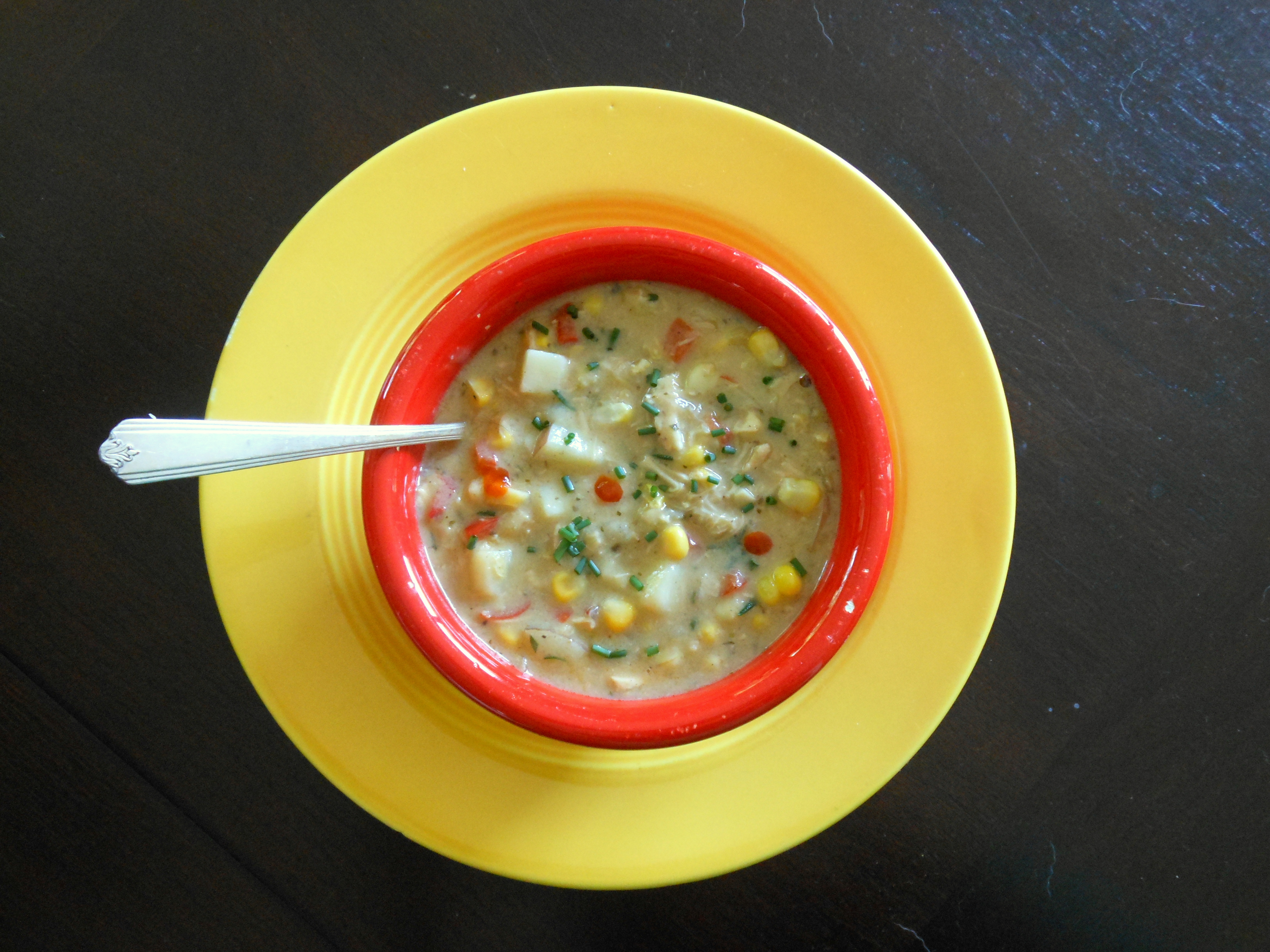
Sweet and spicy corn & chicken chowder

Luke and I flew to New Hampshire last week for a brief family visit. My sister Jul and her family were kind enough to let us and our parents all stay at their house. Jul made some seriously tasty dinners, including a great pork and broccoli stir-fry one night, and grilled chicken with potato salad on another.

I don’t usually like potato salad, so I took a small spoonful to be polite — and went back twice more. I stopped myself from having a fourth helping only because I realized I’d eaten more potato salad than either of our teenaged sons. Jul says she used Ina Garten’s recipe. I’ll be making it soon, to the great delight of Tom, I’m sure.

Speaking of Tom, he’d not only cleaned house while we were gone, but he had dinner waiting when we got home. I don’t have photos of the dish, but it was an old family favorite: his mom’s slow-cooked chicken with water chestnuts and a creamy, cheesy sauce. What a guy.

The leftover chicken was tender and flavorful. Tortilla soup beckoned, but instead I wanted to enhance that velvety texture of the chicken and went with a creamy chowder.

The corn is at peak right now, so it formed the base of the chowder. Red pepper enhanced the corn’s sweetness; a single cherry pepper raised that sweetness and added a touch of heat.

I’d never made chowder before, but I rarely let a lack of experience slow me down (in the kitchen, at least). I’ve made lots of soups before, and chowder is basically a soup with milk (or cream, if you’re feeling decadent) and potatoes. How difficult could it be?

Not difficult at all, it turns out. I wanted — and got — a thinner stock, but if you like your chowder thick, you can 1) boost the level of butter and flour by a few tablespoons, or 2) use cream instead of milk, or 3) purée some of the soup before adding the chicken.

I also like soups that have just enough broth to edge past the stew category. Feel free to play with the liquid-to-solid proportions to get the result you want.

I added a handful of grated sharp cheddar for flavor and creaminess. (That, and I have difficulty making much of anything without adding cheese.) The chowder will still be tasty without it, if you’re not as cheese-obsessed as we are.

I’m sending this post on to Kahakai Kitchen’s Souper Sundays at http://kahakaikitchen.blogspot.com. Look for us there, and see all the other fantastic soup-salad-sammie posts.

Sweet and Spicy Corn-Chicken Chowder
serves 4-6

2 tbs. butter
1 tsp. olive oil
1 small onion, chopped
1 large clove garlic, minced
1/2 red bell pepper, chopped
1 hot red chile, minced (I used a cherry pepper), optional
2 cups corn kernels, fresh or frozen
salt and pepper
3 tbs. chopped fresh basil, divided
1 cup diced potato (I used 2 small red-skinned
1 1/2 tbs/ flour
1 1/2 cups whole milk
2-3 cups chicken stock
2 cups cooked, chopped chicken
1/2 cup grated sharp cheddar, optional
minced chives, for garnish

In a large saucepan over medium heat, melt the butter with the oil. Add the onion and garlic and sauté for a few minutes until softened. Add the bell pepper and chile and cook for about 5 minutes longer. Add the corn and potatoes, sprinkle with salt, pepper, and 1 tbs. of the basil. Increase the heat to medium-high and cook, stirring occasionally, for 3-4 minutes to get a little color on the vegetables.

Stir in the flour and cook for a few minutes. In the meantime, heat the milk and stock in the microwave for one minute. (This helps the soup to thicken without lumps.) Pour the hot milk and stock into the soup gradually, stirring constantly. Stir in the chicken, reduce the heat to medium-low, and simmer, stirring occasionally, for about 15 minutes until the potatoes are tender. Just before serving, stir in the cheddar.

Posted in appetizers, main courses, soups | Tagged , , , , , , | 1 Comment

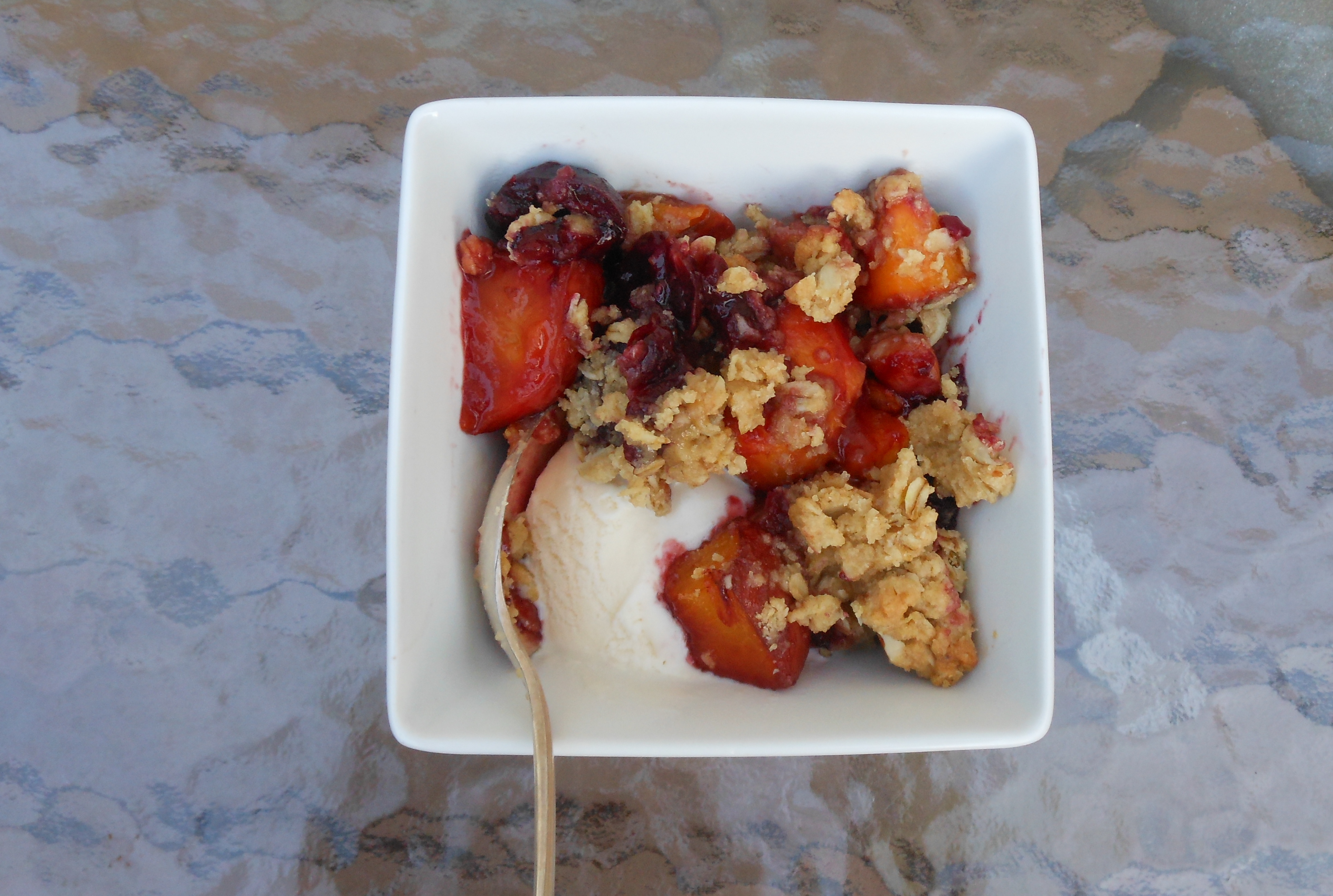
Peach-cherry-almond crisp

The peach is such a decadent fruit: flagrantly colored as a summer sunset and perfumy-sweet, the perfect peach drips juices as you bite into its tender flesh.

The peach is a joy all on its own, but it makes friends easily. Perhaps my favorite appetizer is this: salty, sweet, creamy and crunchy in one fabulous bite.

I’ve made fruit crisps with pears and apples, and with peaches, alone or with a handful of raspberries. But the ruby-red cherries were calling to me today. The fruit was so lusciously sweet, it needed little more than a touch of brown sugar and a fine grating of nutmeg.*

*Please, please use real, whole nutmeg and grate it yourself. The powdered stuff in a jar does not begin to compare to the real thing. And if I can find whole nutmegs in the wilds of central Wisconsin, you can find them too.

In theory, a crisp is a pretty healthy dessert. In theory, it is mostly fresh fruit with a light sprinkle of topping, which contains oats and nuts. Heck, you could eat it for breakfast and feel virtuous.

But that darned topping is so fantastic that we tend to pile it on. And I may have forgotten to mention that it also contains butter and brown sugar. So follow your own conscience in the proportions of this dish. If you have more moral fortitude than we do, by all means boost the fruit-to-topping ratio to saner levels.

Peach-Cherry-Almond Crisp
makes about 6 servings

3 ripe peaches
3 cups pitted fresh cherries (we used bing)
2 tbs. flour
1 heaping tbs. brown sugar (or more, if the fruit needs it)
about 1/4 tsp. freshly grated nutmeg

Topping:
1 stick butter
1 cup all-purpose flour
1/2 packed brown sugar
1/2 tsp. freshly grated nutmeg
1/2 cup coarsely chopped almonds
1/4 tsp. salt

Heat the oven to 375 degrees F.

Cut the peaches into 2-inch chunks and place in a large bowl. Add the pitted cherries (I cut them in half as I pitted them). Stir in the 2 tbs. flour, the 1 tbs. brown sugar, and a few gratings of nutmeg. Taste and add more sugar if the fruit needs it.

In a small bowl, mash together the topping ingredients. I use my fingers. Pour the fruit into a 10-inch pie pan or casserole. Sprinkle the topping over the fruit. Bake for 30-40 minutes until topping is golden and fruit is tender. Serve hot (with perhaps a scoop of ice cream), warm or cold. Store leftovers in the fridge.

Posted in baked goods, sweet stuff | Tagged , , , , , , , , | Leave a comment

Tomato-pesto grilled cheese


A fast lunch with summer’s bounty: just-picked tomatoes and homemade pesto. I grew up eating grilled cheese and tomato sandwiches. Luke is a huge pesto fan; his go-to snack or quick lunch is grilled cheese with pesto-slathered bread. The combination is summer on a plate.

Our tomato plants are prima donnas this scorching summer, thriving one minute and drooping from lack of moisture the next. But they are managing to produce some tasty fruit.

The basil plants, on the other hand, are loving the heat. I’ve cut them back ruthlessly three times now, and they shoot right back up in no time. We now have a goodly stash of pesto in the freezer, and I should get at least one more batch.

Pesto is more of a process than a recipe. Put a clove of garlic and some nuts (I often use walnuts, but pine nuts are traditional) in the bowl of your food processor. Add a good glug of olive oil and give it a whir. This preliminary purée ensures that you don’t bite into a hunk of raw garlic later.

Add handfuls of clean, dry (via salad spinner) basil leaves and pulse again. Keep adding basil and oil and puréeing until the texture looks good to you. Add a pinch or two of salt, a few grinds of pepper, and a few tablespoons of grated parmesan. Taste. I end up using about 4 cups basil leaves, 1 big clove garlic, 1/4 cup nuts, and about 1/2 cup oil. I also like to add a small handful of parsley and maybe some mint.

When it’s done, scoop some into a jar, slap on a lid, and keep it in the fridge for about a week. Put the rest into an ice cube tray and into the freezer. After a few hours, pop out the cubes and store them in a freezer bag. Each cube is about 2 tablespoons.

Sharp cheddar brings some intense cheesy flavor; Monterey jack offers a buttery, creamy texture. I like a little of each, but use whichever cheese makes you happy. Fresh mozzarella would turn this into a grilled caprese sandwich, for instance. (I may give this a shot with some brie.)


Tomato-Pesto Grilled Cheese
1 sandwich

1 small tomato
1/2 oz. sharp cheddar, about
1/2 oz. Monterey jack, about
4-5 tsp. butter, softened
2 slices good bread
2 tbs. pesto
salt and pepper

Thickly slice the tomato. Slice the cheeses thinly. Spread half the butter on one side of one slice of bread. Spread the pesto on the other piece of bread.

Melt the remaning butter in a small skillet over medium heat. Place the pesto-covered slice of bread in the pan, pesto side up. Swirl the bread around a bit to coat the bottom well with the butter. Top the pesto with the cheddar slices, then with the tomato slices. Sprinkle lightly with salt and pepper. Top with the Monterey jack, then the second slice of bread, buttered side up. Press lightly with a spatula and cook for about 5 minutes until deep golden on the bottom. Carefully flip the sandwich; cook for about 3 minutes until the second side is golden. (The second side always cooks much faster, so don’t leave it too long before you check.)

Posted in main courses | Tagged , , , , , , | 3 Comments