Fast and easy dark chocolate cake

The old-fashioned name for this dessert is dump cake. In the interests of expediency, you dump the dry ingredients into the baking pan and stir them. You then add the oil, vinegar, and vanilla, give it a stir, and pour a cup of cold water over. A few whisks to combine, and the pan goes in the oven. No fuss, very little muss, and 40 minutes later you have a cake.

I tend to be particular about blending, so I whisked the wet ingredients together in a large measuring cup, then stirred them into the dry ingredients in the pan. This is not, as I’ve said, necessary. Greasing and flouring the pan is also unnecessary, since the pan is also the mixing bowl.

The result is a chocolate cake that’s moist without being dense, and not overly sweet. For those with dietary issues, cake is eggless, and if you don’t use milk chocolate chips, dairy-free. The chocolate chips and walnuts weren’t part of the original recipe, in fact. You may omit them, or switch it up: add pecans or hazelnuts instead of walnuts, white chocolate or even butterscotch chips if that’s your thing. I’m thinking a handful of coconut and some pecans might be a tasty combo.

Frosting is another possibility, if you’re so inclined. I tend to like the cake as is, but I have been known to sneak in a scoop of ice cream on the side.

Really, this cake’s biggest asset is that in the time it takes to make a boxed brownie mix (not that there’s anything wrong with that), using ingredients you probably always have in the pantry, you have a made-from-scratch, dark, luscious cake. Enjoy!

This just in: I was just interviewed by Food Blog Radio. Gary House, a food blogger himself, created and hosts FBR, which runs profiles of food bloggers (podcasts and YouTube videos) about once a week. Look for the Rivertree Kitchen interview in about a month (I’ll post a link), and many thanks to Gary for creating such a great resource.

Double Chocolate-Walnut Cake
makes one 9-inch cake

1 1/2 cups flour
1 cup white sugar
1 tsp. baking soda
3 heaping tbs. unsweetened cocoa powder
1/2 tsp. salt
6 tbs. vegetable or canola oil
2 tbs. vinegar (white or cider)
1 tsp. vanilla
1 cup cold water
1/2  cup semisweet chocolate chips
1/2 cup chopped walnuts

Heat the oven to 350 degrees F. Pour flour, sugar, baking soda, cocoa powder, and salt into a 9-inch pan. Stir until well combined.

In a large bowl or measuring cup, preferably with a spout, whisk together the oil, vinegar, vanilla, and water until well mixed. Pour into the dry ingredients in the pan. (You may also simply dump the wet ingredients into the dry right into the pan, if you prefer.) Stir just until combined. Stir in chocolate chips and walnuts. Bake for 40 to 45 minutes until a toothpick inserted in the center comes out clean.

Posted in baked goods, sweet stuff | Tagged , , , , , , | 2 Comments

To the letter, or not? Grandma’s dressing

First, accept my apologies for committing the cardinal sin of posting without a photo. I wrote this draft at Thanksgiving (obviously); I got caught up in the holiday celebrations and forgot to bring out my camera. A modestly edited version of this post currently appears on The Lyon Review, Mount Holyoke College (my alma mater)’s literary magazine, in their food issue.

Renowned chef and author David Leibovitz said on a recent blog post about helpful kitchen tips that we shouldn’t substitute ingredients when following a recipe. His reasoning is that the author has put in a lot of time, experience and experimentation in creating that recipe, and you should respect that.

I certainly agree with the logic, even though it goes against my blog’s reason for being (“Think outside the recipe” is my tagline, after all). I do put time and thought into my recipes, tweaking them to get them just right. And I certainly have respect for the cooks who wrote the recipes in cookbooks or on blogs, as well as the brilliant David Lebovitz himself, who knows a heck of a lot more about cooking than I do.

Here’s where I run into a problem with that sentiment: I think it’s essential for good cooks to be able to think on their feet. That skill develops when you are willing to veer outside the lines.

This issue came up with our Thanksgiving dressing. (Yes, dressing; we are not “stuffing” people in our house.) My Grandma Ruth’s dressing is the only way to fly. It’s very simple: Riley’s beef sausage, Nabisco Royal Lunch crackers, onion, sage, and water.

Here’s the thing: Riley’s, a small-town butcher shop in Massachusetts who made their own sausage, closed a good twenty years ago, and Nabisco stopped making Royal Lunch crackers in 2007. (At this posting, onion and sage are still available.)

Through experimentation, we’ve found that plain, uncooked (not smoked or cured) beef bratwurst is a very close substitute for Riley’s sausage. The crackers are more of a challenge. We’ve tried Saltines, Bremner’s Wafers, and panko breadcrumbs with mixed results. Last year, I used a combination of unsalted water crackers, oyster crackers, and stale but excellent white bread. The result was delicious, if not exactly the same as Grandma Ruth’s. This year, my mother sent me a box of Heritage Mills Classic Milk Lunch Crackers, which are a near-perfect match. (We’re looking for a dry, very bland cracker; they are the blank canvas that lets the other ingredients shine.)

When I was a youngster, we’d pull out the old cast-iron meat grinder when it was time to make the dressing. I use a food processor now. I finish by squishing the whole mixture between my fingers to get the right texture anyway, so I don’t miss the grinder.

In the olden days, we cooked the dressing inside the turkey.  Since I tend toward obsession with food safety, my dressing cooks alongside the turkey in its own pan. But without the constant bath of  turkey juices, the dressing lacked flavor. So I now use chicken stock to replace half the water.

The best part of the dressing is the crunchy golden crust. Enter the muffin tin; now each diner has a generous serving of crust. To prevent the dressing “muffins” from becoming too dry, I increase the proportion of liquid to dry in the mix, and lightly baste the tops with melted butter before they go in the oven. Boosting the oven temperature allows the crust to develop quickly, while keeping the centers moist.

What it comes down to is this: We honored Grandma Ruth’s recipe for as long as we could. It can be especially painful to experiment with holiday dishes, but if we weren’t able and willing to alter the original recipe, my grandmother’s beloved dressing would have been lost. I think of her every time I serve our version. She would approve.

Grandma Ruth’s Sausage Stuffing (modern-day version)
makes a 9-inch pan or casserole, or about 9 “muffins”

1 box (1 lb.) Heritage Mills Classic Lunch Milk Crackers (or other bland, dry, unsalted crackers)
1 medium onion, quartered
2-3 raw (not cured or smoked) bratwurst, preferably beef
3/4 cup chicken stock
3/4 cup water (or more)
1/2 tsp. dried sage
black pepper
1 tsp. mild cooking oil
salt to taste
1 tbs. melted butter, about, optional

If you can, prepare the raw dressing mixture several hours or even a full day before you plan to cook it. This allows the cracker crumbs to hydrate and the flavors to meld.

Break the crackers into the bowl of a food processor, and pulse until they’re mostly fine crumbs with a few small pieces left. Pour into a bowl. Pulse the onion in the food processor until it’s very finely chopped; if it purées that’s fine. Add about 3/4 of the cracker crumbs to a big bowl. Pour the onion on top, then add the stock. Squeeze the sausages out of their casings onto the mixture. Add the sage and pepper.

Squeeze the mixture between your fingers, adding water as necessary, until the mixture is very moist but not runny, and well combined. Add more of the reserved crackers if it’s too runny, or if you want more of a cracker-to-sausage ratio. The mixture should be a little more moist if you’re planning on cooking in muffin tins than if you’re baking it in a casserole.

Heat the oil in a small skillet over medium-high heat. Add a rounded teaspoonful or so of the dressing mixture. Flatten it slightly and cook, flipping once, for about 3-5 minutes until it’s cooked through. Taste. If it needs salt (or pepper, or more sage), adjust the seasonings in the raw mixture. Cover tightly and refrigerate, ideally for several hours.

When you’re ready to cook, pack the mixture into a greased 9-inch pan or casserole dish. Bake along with your turkey. If it’s at 350 degrees F, give it about 45 minutes; if you’re at 400 degrees F,  30 minutes will do.

Or fill very well-greased muffin cups to heaping with the dressing mixture. Brush the tops with melted butter. Bake for about 20 minutes until cooked through and browned on top. If this is a side dish with turkey, you can pop the dressing in the oven (400 degrees F, please) as soon as the turkey comes out; the dressing will cook while the turkey rests.

Serve hot, with turkey and gravy. Or mash the dressing, warmed or cold, onto some good bread for a post-dinner sandwich, with or without turkey and cranberry sauce.

Posted in meat, poultry,and fish, sides | Tagged , , , , , | 3 Comments

Herb-stuffed pork tenderloin

porkstuffed+grapesTom and I met years ago in Washington, DC, where politics influence every aspect of daily life. We were on hand for more than one presidential inauguration, and went to an inaugural ball together.

Four years ago, in Wisconsin, we decided to host our own inaugural “ball,” a sit-down dinner for a dozen friends in formal dress. It was a huge success, if we do say so. We disguised our deck table with a damask tablecloth for extra seating, and had lots of flowers and candles. We had so much fun that we decided to repeat it this year.

I wanted to make something this side of elegant, but that wouldn’t have me in the kitchen all evening while the guests were mingling. Something I could prepare mostly ahead of time, but wasn’t as casual as a stew or casserole. Something not overly rich, so as not to disrupt any post-New Year’s intentions of healthy eating.

Pork tenderloins are very lean and quick to prepare. To gussy them up, I roll-cut them flat and reassembled them with a spiral of aromatics and bright green herbs. The stuffing not only looked elegant, it added rich flavor to the mild meat. Since the tenderloins benefited from a rest in the fridge before cooking, I could do all the prep in the morning.

I roasted grapes right along with the pork, but you can certainly roast the grapes separately, or leave them out altogether. The winy fruit is an unexpected, subtly sweet complement to the pork. To balance that fruity flavor, I whisked some dijon mustard into the sauce at the end.

We put out parmesan-pistachio shortbreads to nibble on beforehand, and served the tenderloins with roasted shallot smashed potatoes (which hold very well in a slow cooker on low, by the way). Our guests brought a smoked salmon appetizer, a green salad, and a chocolate zucchini cake decorated like a flag with strawberries and blueberries. Good friends and good food–it was, overall, a lovely way to usher in the new year.

porkstuffed+grapes1

Herb-Stuffed Pork Tenderloins with Roasted Grapes
serves 4-6

1/2 cup minced shallots
2 small cloves garlic, minced
1 stalk celery, minced
2 tbs. fresh celery leaves, minced
2 tbs. fresh thyme, minced
1/4 cup parsley, minced
1 tbs. grated lemon zest
1/4 cup panko breadcrumbs
3 tbs. olive oil, divided
salt and pepper
2 pork tenderloins (about 1 lb. each)
1 lb. seedless red grapes
2 cups chicken stock
2 tbs. dijon mustard

Although you can stuff the pork and cook it immediately, it’s best if you can prepare it several hours in advance. In a small bowl, stir together the shallots, garlic, celery, celery leaves, thyme, parsley, lemon zest, panko, and 2 tbs. of the oil. Season with salt and pepper.

Cut two long pieces (about 36 inches) of kitchen twine; set aside. Trim fat and silverskin from the tenderloins. What we’re doing now is transforming a cylinder of pork into a 1/2-inch-thick rectangle of pork. Lay one tenderloin on your cutting board perpendicular to you. Hold a long, sharp knife parallel to the cutting board about 1/2 inch above it. Cut into but not all the way through the length of the tenderloin. Roll it open and make another cut in the thicker part, where the first cut ended. Roll it open again and continue until you have a rectangle of meat roughly 1/2-inch thick. At this point you can cover it with plastic wrap and pound it lightly to make it thinner, but it’s not necessary. Repeat with the second tenderloin.

Season the meat well with salt and pepper. Spread half the herb mixture over one tenderloin. Gently roll the tenderloin up, taking care not to squeeze out the stuffing. Tie the roll snugly every inch or so, tucking in the edges as you go. Repeat with the second tenderloin and the remaining stuffing. Wrap them well and stash in the fridge for up to eight hours.

About an hour before dinner, heat the oven to 400 degrees F. Place a very large (12-inch) skillet* or cast iron pan over high heat and add the last tablespoon of oil. When the oil is shimmering but not smoking, season the outsides of the pork with salt and pepper and add them to the pan. Sear them for about 5 minutes per side until they’re well-browned. Add 1 cup of the stock to the pan, give a quick stir to loosen up the browned bits. Scatter the grapes around the tenderloins and put the pan in the oven.

[*Note: if your skillet has a plastic handle, cover the handle tightly with foil before putting it in the oven.]

Roast uncovered until the thickest part of the tenderloin reaches 150 degrees on a meat thermometer. At this temperature the meat will be tender, safely cooked through, and slightly pink in the center. If that pink makes you nervous, give it another 5 minutes.

Remove the tenderloins to a platter. Using a slotted spoon, remove the grapes and add them to the platter. Cover with foil and set aside in a warm place to rest while you make the sauce.

Place the pan over high heat and stir in the remaining cup of stock. Boil for a few minutes until the flavors are concentrated and the sauce is slightly thickened. Whisk in the mustard. If you want a thicker sauce, you can mash together a tablespoon of soft butter with a tablespoon of flour and whisk it into the sauce.

Slice the tenderloins about an inch thick to show off the pretty swirl of herbs. Serve with the grapes tucked around the slices, and the sauce on the side.

Posted in appetizers, meat, poultry,and fish | Tagged , , , , , | Leave a comment

Thai chicken in the pressure cooker

thaipeanutchix

First, and most urgently: Rivertree Kitchen’s molasses cookie recipe is a finalist in a Whole Foods cooking contest! If you’re reading this before January 12, 2013, head over and vote for us!

On to business: Lately my friend and fellow culinary aficionado Tom (known as Thomas Arthur, to distinguish him from my Tom, Thomas Matthew) has been extolling the virtues of the pressure cooker. He had an ulterior motive: he just bought a new pressure cooker, and wanted me to buy his old one.

I spent a recent Saturday morning at his house, learning the ropes while Tom and his wife made chicken cacciatore for their a party. Nine minutes, people. Yes, once the pressure cooker was up to speed, it took nine minutes to take that poultry from raw to fall-apart, cooked-all-day deliciousness.

Needless to say, I headed home with Tom’s second pressure cooker (at a bargain price; thanks, T.A.). I cooked a vat of wild rice the same day; it took 20 minutes for 7 cups of cooked rice. Since then, I’ve been surfing for intriguing pressure cooker recipes.

Pressurecookingtoday.com had many tempting dishes. We chose this recipe to try because we’re big fans of Thai peanut sauce.

I tweaked this recipe just a bit, reducing the level of soy sauce so I could salt the chicken before it browned, and adding a little brown sugar for balance. I also replaced the hot pepper flakes with sriracha; there’s nothing wrong with hot pepper flakes, but I’ve been on a hot sauce kick lately.

Since I generally start sautéing onions and garlic while I decide what to make for dinner, I added both to this recipe. We had a handful of frozen pearl onions left over from our New Year’s Eve fondue (a future post); otherwise, chopped onions would be fine.

The caramel-colored sauce is creamy and smooth, with a delayed heat from the ginger and sriracha. The flavor permeates the chicken, which is fall-apart tender. I served it over steamed rice with roasted broccoli and bell peppers. It would be equally fabulous over soba noodles with shredded carrots. Amazingly, it took less than half an hour, counting prep time.

[I’m not teaching you how to use a pressure cooker here; more informed people than I can do that for you.]

Pressure-Cooker Chicken in Thai Peanut Sauce
adapted from pressurecookingtoday.com
serves 4-6

3/4 cup chicken broth, divided
2 tbs. soy sauce
juice of 1 lime or half a lemon
1 tsp. grated ginger
2-3 tsp. sriracha
1/4 cup peanut butter
1 clove garlic, grated
8 skinless chicken thighs, trimmed of fat
salt and pepper
2 tbs. olive or canola oil
1 cup frozen or blanched pearl onions, or 1 small onion, chopped
2 tbs. cornstarch

In a small bowl, whisk together 1/2 cup of the chicken broth, soy sauce, lime juice, ginger, sriracha, peanut butter and garlic. It may not combine well at this point; that’s fine.

Sprinkle the chicken lightly with salt and pepper. Heat the oil in the pressure cooker over high heat until hot but not smoking. Add half the chicken and cook for 3-5 minutes per side until nicely browned. Remove the browned thighs to a bowl and repeat with the remaining chicken. Remove those thighs when browned. Add the onions; cook for 2 minutes until softened, stirring to scrape up the browned bits.

Add the sauce and bring to a boil, stirring. Add the browned chicken along with any juices. Stir once to coat the meat with the sauce. Place the lid on the pressure cooker, lock it, and bring to high pressure. When the top valve begins to rattle (or when your pressure cooker reaches full heat), set the timer for 9 minutes.

When the timer goes off, use the quick-release method (in my case, this means placing the pot in the sink and running cold water over it until the steam stops releasing and the valves descend back into the lid). Remove the lid and place the pot back on the stove over medium-low heat.

In a small bowl, whisk together the remaining 1/4 cup chicken broth with the cornstarch. Whisk about half the cornstarch mixture into the sauce and bring it to a boil. Cook for a minute or two until the sauce thickens. Add more cornstarch mixture if you want a thicker sauce; stir in a little extra broth to thin it out. Serve over rice (preferably brown) or soba noodles.

Posted in main courses, meat, poultry,and fish | Tagged , , , , , , , | 1 Comment

Approach life like cooking

snowsunriver

The river in our backyard, after a pre-Christmas snowfall.

Lately I’ve been thinking that cooking — or at least my style of cooking — is a perfect example on how to approach daily life.

I’ve never been overjoyed with failure (who is?), and I’ve been known to let setbacks derail me completely. One rejection letter from a potential publisher or future client is enough to make me freeze in my tracks.

Yet that attitude never enters my kitchen. As you know, most of my cooking is experimental. I dive in and try new things all the time, without fear. Culinary failures don’t derail me; I see them as educational opportunities. My ego survives intact.

My resolution, then, is to tackle other aspects of life the way I approach cooking: take risks based on knowledge, be open to adjustments as needed, and never stop learning, especially from mistakes.

My friend Brett over at Trout Caviar puts it this way: Charge ahead, fall down, get up, repeat. I love that. Happy new year to you all.

Posted in not food | 2 Comments

Cheddar-chive biscuits

biscuits2
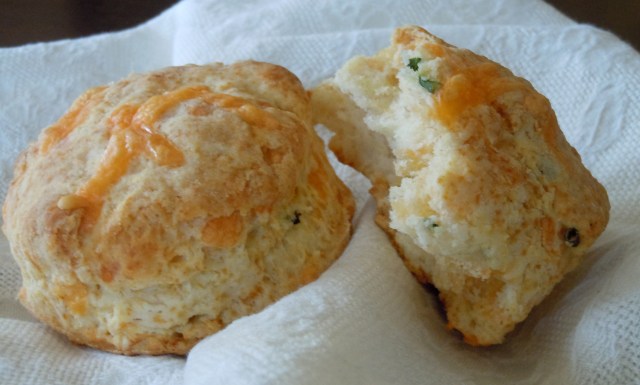
Biscuits! Light, flaky, rich, and cheesy (and remarkably speedy to make), they make frequent appearances at our house. They’re decadent, so I usually serve them with something healthy, such as soup or big salads.

I hear that you are not considered a real Southerner unless you can make a properly light, flaky biscuit. I’m a quintessential Northerner: the majority of my ancestors came from Canada and Scotland. This, I feel, exempts me from the pressure to make a flawless biscuit.

These are darned close, though. If you use very cold butter and don’t over-mix, your biscuits will be light. I cut the butter into small cubes and smear them into the dry ingredients with the tips of my fingers. This ensures that some of the butter is fully incorporated into the flour and some is left in small, flattish pieces the size and shape of cornflakes. Those butter flakes steam as the biscuits bake, creating air pockets in the dough.

There’s some discussion on whether it’s better to place the biscuits close together or to give them space. I’ve tried both; mine tend to rise a little more if they’re nearly touching. Let me know what you think. A juice glass makes a terrific biscuit cutter if you dip the rim in flour after every cut.

I’ve made these with whole milk when we were out of half-and-half; they were just fine. I’ve also made them with pepper-jack instead of cheddar for a little heat. Chives are pretty and add a subtle onion flavor, but it’s fine to leave them out when they’re out of season. A glaze of cream or beaten egg on the top of the dough gives a golden crunch.

Cheddar Biscuits
adapted from Silver Palate: The New Basics by Julee Rosso and Sheila Lukins
makes ten 2-inch biscuits

1 1/2 cups flour
1/4 tsp. sugar
1 tsp. salt
1 tbs. baking powder
6 tbs. (3/4 stick) cold butter, cut into small cubes
3/4 cup grated sharp cheddar
9 tbs. half and half or whole milk (1/2 cup + 1 tbs.), cold
1 tbs. minced chives, optional

Heat the oven to 425 degrees F. Butter a cookie sheet or small baking pan.

In a mixing bowl, stir together the flour, sugar, salt, and baking powder. Mix in the butter. Use two knives, a pastry blender, or your fingers. I like to squeeze the butter bits between my fingers quickly, creating thin sheets of butter. Be careful not to let the butter warm up. You’re not looking to have all the butter completely incorporated here.

Once some of the butter is well mixed in and there are still bits and flakes here and there, quickly stir in the cheddar. Pour in the half and half and stir with a fork just to combine. As soon as the dough barely holds together, dump it out onto a floured surface. Knead it a few times, then pat it into a circle just under an inch thick.

Flour the edges of a 2-inch round cookie cutter or juice glass and cut one biscuit right at the edge of the dough. Twist to release the biscuit and set it on the prepared pan. Dip the cutter into flour again and repeat until you can’t cut any more biscuits. Gently push the remaining dough together and cut one more, then form the final scraps into a mound roughly the same thickness as the biscuits.

Brush the tops with extra cream or a beaten egg. Bake for 15 minutes until the tops are golden and the biscuits are puffed and flaky.

Posted in baked goods, sides | Tagged , , , | 5 Comments

Mustard-braised chicken thighs and carrots

Two separate blogs inspired this dish. I saw this roasted carrot recipe on Storey Publishing’s blog page (I am lucky enough to edit and proofread books for Storey). We adore cooked carrots, but it had never occurred to me to highlight their savory side so emphatically. Bonus: Jess’ writing is beautiful and absorbing. I’m following her blog Hogwash as of now.

Then I got an update from another blog I’ve followed for a while, Trout Caviar, by my pal and fellow Wisconsinite Brett Laidlaw. He wrote about the joys of a long, slow braise. Sure, meats cooked to melting tenderness are terrific, but Brett points out that it’s easy to fall into a trap of flavor sameness. He proposes using acidic liquids and a creative raid of the spice cabinet to expand the braising horizons. His braised lamb with sichuan peppercorns (hua jiao), cider vinegar and turnips is slow cooking at its best.

I’ve braised chicken thighs and roasted carrots plenty of times but, inspired by my fellow bloggers, this time I used white wine and a generous amount of sharp dijon mustard to wake up the warm coziness of the dish. The result is still comforting, but with a surprising bite. The sweetness of the carrots balances the acidity of the wine and mustard. My instinct was to whisk in a drizzle of honey to soften all that sharpness, but I’m glad I didn’t; the brightness would be too muted.

I used boneless, skinless thighs because I’m healthy that way; leave skin and/or bones if you prefer. I’m thinking a bone-in turkey breast would be mighty tasty with this treatment. Parsnips would be a perfect  substitute for the carrots.

Mustard-Braised Chicken Thighs with Carrots
serves 4

2 tbs. olive oil, or a bit more if needed
1/2 cup flour
8 chicken thighs
salt and pepper
1 tsp. dried thyme, or 1 tbs. fresh
1 medium onion, chopped
2 cloves garlic, minced
4 large carrots, peeled and cut into chunks
1/2 cup white wine
2 heaping tbs. dijon mustard
1 cup chicken stock

Get your stockpot or dutch oven heating up over medium-high heat with the oil. Season the chicken liberally with salt, pepper, and the thyme, then dredge in flour. Shake each thigh to remove excess flour, then put them in the hot pan. Cook without moving for about 5 minutes until well-browned; flip the chicken and brown well on the second side. You’re not looking to cook the chicken through at this point.

Remove the chicken to a bowl and set aside. Add the onions, garlic, and carrots to the pot, along with a few teaspoons of oil if the pan’s too dry. Cook for a few minutes until the veggies begin to soften. Add the wine and stir to scrape up the browned bits at the bottom of the pan. Whisk in the mustard until it’s incorporated, then stir in the stock. Tuck the chicken back in. Reduce the heat to medium-low, cover the pan, and cook for 45 minutes to an hour until the carrots are tender and the chicken is falling apart.

Serve as is. Or for a smoother sauce, remove the chicken and carrots to a serving dish, then purée the sauce with an immersion blender or in the food processor, or force through a sieve.

Posted in main courses, meat, poultry,and fish | 2 Comments

Cookie Swap! Browned butter-pecan bars with chocolate ganache

At this time last year, I took part in the Great Food Blogger Cookie Swap, the brainchild of Lindsay of Love & Olive Oil and Jenny of The Little Kitchen. The premise: anyone with an established food blog could participate. We were each supplied with contact info for three other bloggers. We then made a batch of cookies, and sent a dozen to each blogger on our list. In turn, we received a dozen cookies from the three bloggers who’d received our names.

This year, each participant donated $4 to Cookies for Kids’ Cancer. Oxo generously matched the full amount, making this event even more special.

So far, I’ve received pretty Cranberry-Hazelnut Cookies from Stephanie of Life Tastes Like Food, and moist, tender Black and White Cookies from Brigitt at cook with b. I’m looking forward to our third package today.

Last year, I made Clementine-Cherry Biscotti with a festive drizzle of dark chocolate. For this year’s Cookie Swap, I wanted a sturdy, delicious cookie that would be even tastier after a few days. A lovely book called The Art of the Cookie by Jann Johnson provided the answer. I used to refer often to this book when Luke was little (in fact, the book was published the year he was born). So many choices!

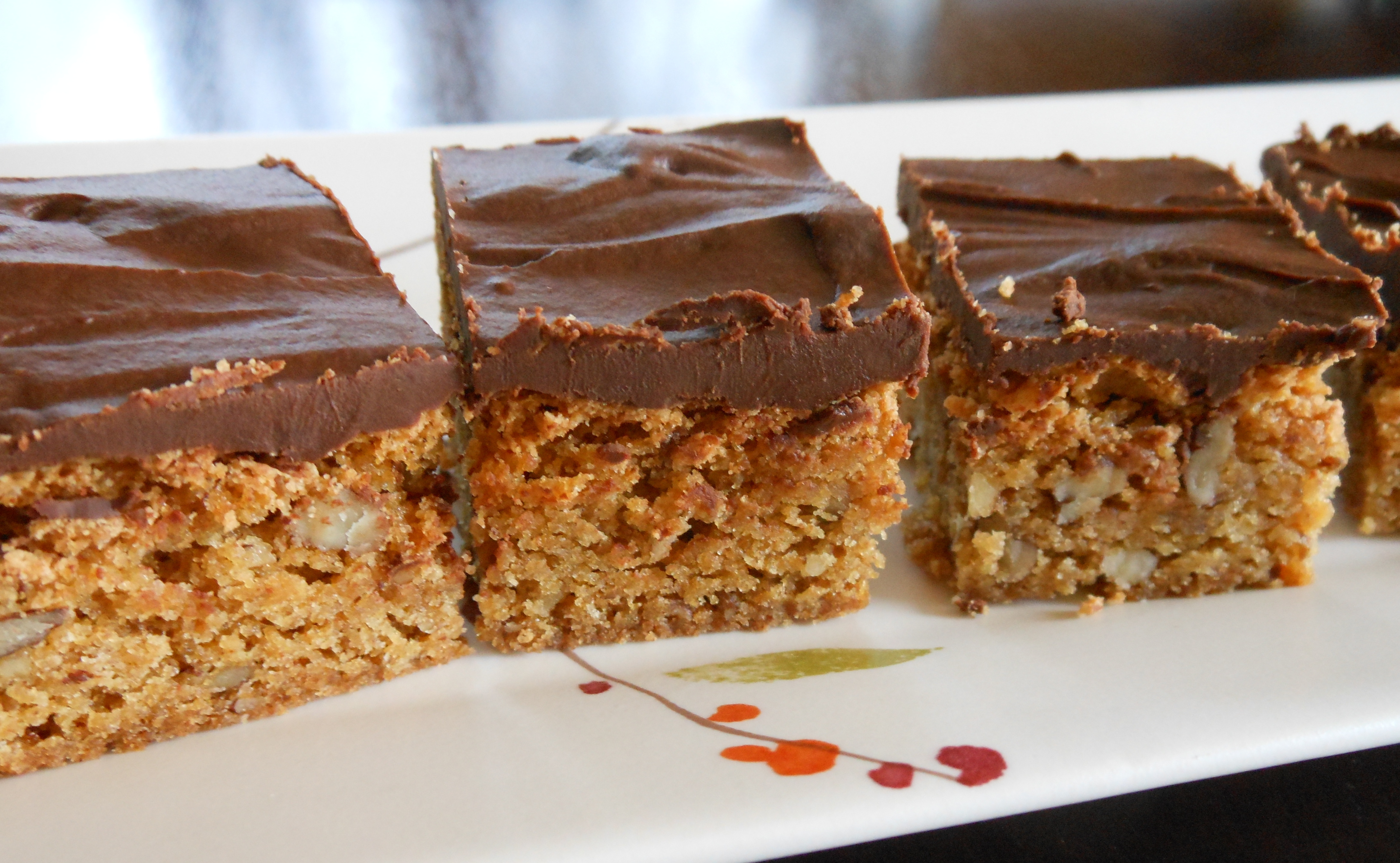
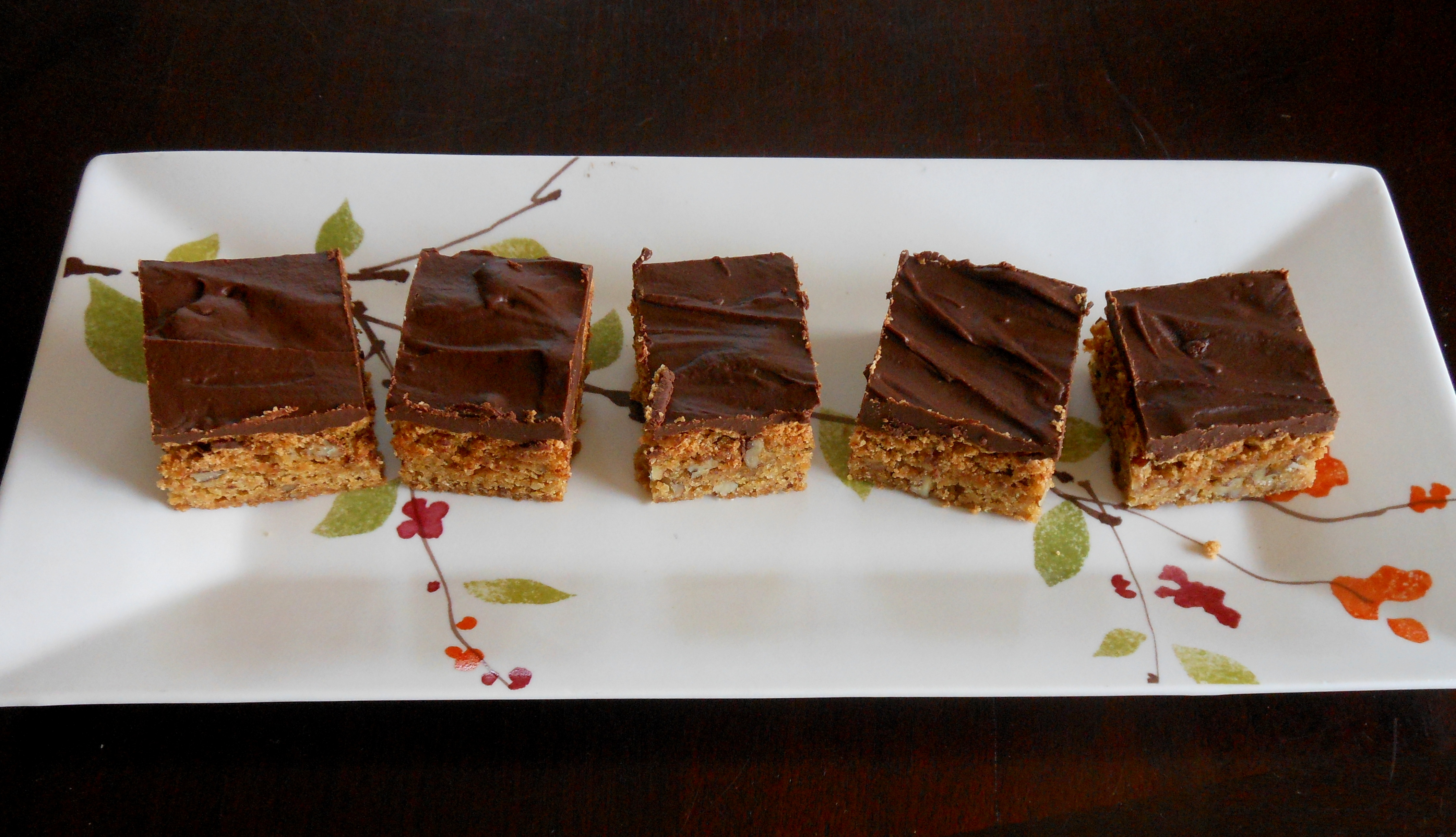
I went with Jann’s Browned Butter Pecan Bars, a rich, caramel-flavored shortbread square laden with sweet pecans. I gussied them up with a chocolate top. In the past, I’d just spread chocolate chips over the hot bars and smoothed them as they melted. The problem: when cooled, the chocolate layer tended to separate from the cookie underneath.

Chocolate ganache to the rescue. Ganache is simply chocolate melted with heavy cream. Use 2 to 3 parts chocolate to 1 part cream and you have the base for chocolate truffles. Add more cream for chocolate frosting the perfect texture for spreading. I went with 8 parts chocolate to 1 part cream; I wanted the chocolate to set up firmly. The cream adds just a hint of softness that allows the top to meld with the cookie.

We served the test batch three days after they were made, along with scoops of blood orange sorbet. So heavenly. I recommend cutting them into very small squares for two reasons: 1) they are quite rich, and 2) you can take more than one and feel less guilt.

Browned Butter-Pecan Bars with Dark Chocolate Ganache
adapted from The Art of the Cookie by Jann Johnson (Chronicle Books, 1994)
makes 25 small bars

1 cup flour
3/4 tsp. salt
1/2 tsp. baking powder
6 tbs. (3/4 stick) plus 1 tsp. butter
3/4 cup firmly packed brown sugar
1 egg
1 1/2 tsp. vanilla
1/2 cup finely chopped pecans
1 cup good-quality semisweet or bittersweet chocolate chips
or chopped chocolate
2 tbs. heavy cream

Heat the oven to 350 degrees F. Line a 9-inch square baking pan with enough foil to drape about 6 inches beyond two sides. In a small bowl, whisk together the flour, salt, and baking powder.

Put the butter in a medium saucepan and melt it over medium heat. As soon as the butter has melted, start swirling the pan every 30 seconds or so and STAY PUT. Cook that butter, swirling often, until it’s nicely browned. It will go from golden to brown to burned in less than a minute, so watch carefully.

Remove the butter from the heat. Brush a little of it on the foil in the pan (the reason for that extra teaspoon’s worth). Set the butter aside for a few minutes to cool.

Stir the brown sugar into the butter until well mixed. Whisk in the egg, then the vanilla. Stir in the dry ingredients until well combined; it will make a sticky, thick batter. Spread it evenly into the buttered pan. Bake for about 30 minutes until it’s lightly browned at the edges and cooked through.

Cool for about 15 minutes. Then put the chocolate and cream in a small microwave-safe bowl. Microwave on high for 30 seconds. Give the mixture a stir; it will probably need more time to melt fully. Microwave for another 20 to 30 seconds. Stir again until the mixture is glossy.

Spread the chocolate evenly over the entire surface. Set aside for a few hours to cool completely. Cut into small bars.

Posted in baked goods, sweet stuff | Tagged , , , , , , | 6 Comments

Chicken-parmesan pot pies

For Luke’s birthday last weekend (my child is 18! How did that happen?), he stuck with the family tradition and requested chocolate soufflés as his birthday “cake.” Our ramekins had somehow vanished, so I bought new ones. They were the inspiration for dinner tonight – pot pies.

My piecrust is of the cardboard variety, tough, bland, and basically inedible. (Resolution for 2013: skip the excuses and learn how to make a respectable crust.) Luckily, thanks to the miracle of modern science, we have the queen of all pastries — puff pastry — in our freezer. I’ve used it for asparagus tarts with great success; now it’s the topping for lovely little pies.

Puff pastry does all the hard work for you. Cut it out and drop it over the filling; it fulfills its destiny and reaches lofty heights in the oven: golden,flaky, buttery, light-as-air heaven.

For a first attempt at pot pies, I stuck with the traditional filling of peas, carrots, and chicken. I sautéed the chicken in a skillet rather than poach or roast it. This resulted in a skillet full of those magical browned flavor bits called fond. Cooking the veggies and building the sauce in the pan with the fond incorporates all that deep richness into every bite.

Add more chicken if you wish. Skip the cream if you want to save calories, although frankly, you’re using puff pastry, which is a pile of butter disguised with a little flour. The same holds for the parmesan; skip it if it makes you feel virtuous, but it does deepen the flavor.

You could certainly make the filling ahead of time and store it in the fridge. Add 10 minutes to the baking time to let the cold pies warm up. Use this technique with leftover turkey and gravy for some darned fancy Thanksgiving leftovers.

Chicken-Parmesan Pot Pies

makes 4 individual pot pies

2 tbs. butter
1 tsp. olive oil
1 large boneless, skinless chicken breast
salt and pepper
1 medium onion, chopped
2 carrots, peeled and chopped (1/2 inch)
1 stalk celery, chopped (1/2 inch–with leaves)
2 cloves garlic, minced
1 tbs. pesto, or 1 tbs. fresh basil, or 1 tsp. dried basil
2 tbs. flour
2 1/2 cups chicken stock
1/4 cup heavy cream
1 cup frozen peas (no need to thaw)
1/4 cup chopped parsley
1/2 cup grated parmesan
1 sheet (1/2 lb.) puff pastry, thawed but still cold
1 egg, beaten

Heat the oven to 375 degrees F. Set four 8-oz. ramekins on  a cookie sheet.

Melt the butter with the olive oil in a large skillet over medium-high heat. Split the chicken breast through the middle so you have 2 thin pieces. Season liberally with salt and pepper and sauté in the  skillet until browned and just cooked through.

Set the chicken aside and add the onions to the pan. Cook for 5 minutes until softened. Add the carrots, celery and garlic; cook for another 10 minutes until softened. Add the flour and pesto, stir well to combine, and cook for 1 minute. Stir in the stock and cream. Cook, stirring, for about 10 minutes until the sauce is thickened and the carrots are tender. Stir in the peas, parsley,  and parmesan. Chop the chicken into bite-sized pieces and stir in. Remove from the heat.

Roll out the pastry just a little, until the seams are no longer visible. Cut the sheet into quarters. Cut the corners off. Beat the egg in a small cup.

Divide the filling among the 4 ramekins. Top each with one piece of pastry, pressing gently on the edges to seal well. If you wish, decorate with the scraps. Cut a few slits in each pastry top. Brush with the beaten egg. Bake for 45 minutes until the filling is bubbly and the pastry is deep golden. Set aside to cool for 10 minutes before serving, to avoid burned tongues.

Posted in main courses, meat, poultry,and fish | Tagged , , , , , | Leave a comment

Pasta with kale and walnuts: lunch in 20 minutes

Sandwiches are perfectly fine. I have nothing against them, and do partake now and then. But give me a nice bowl of soup or pasta for lunch any day.

After a few days of less-than-healthy eating (fast food, way too much ice cream), my body was rebelling. It doesn’t help that, although I’m on my feet for longer stretches now, I’m still not getting much exercise. If it were summer, I’d build a salad. This time of year, soba with greens is the perfect antidote to this pudgy lethargy.

Our fridge is rarely without a stash of fresh spinach. The guys love it, and I eat it several times a week. If you’re eating the same ridiculously healthy food all the time, is it still a rut? Anyway, it was time to try a different green.

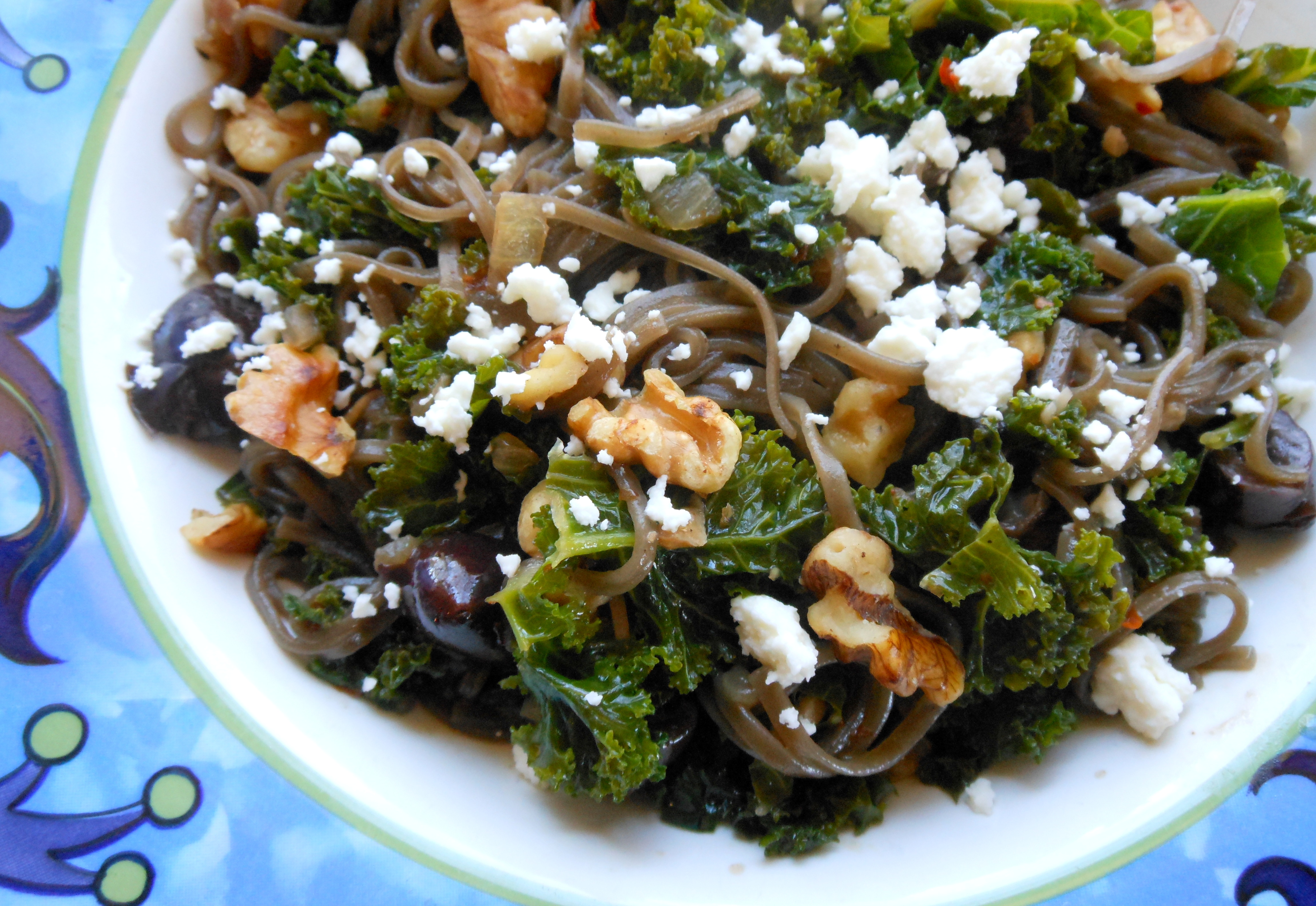
Kale holds its texture better than spinach does when it’s cooked. The sturdy leaves with their frilly ruffles have such a lovely deep, piney green color. I think kale is reminiscent of seaweed, and I don’t mean that in a bad way; it’s pleasantly chewy when cooked, and has a faintly briny taste that’s quite different from spinach.

You’ve heard me extoll the virtues of soba noodles here and here. They’re perfect for lunch or a quick dinner in no small part because they cook in about 4 minutes. Their earthy flavor stands up to the kale, and the nuttiness is enhanced with a handful of toasted walnuts. Add the nuts after you plate the pasta, since if you cook them in the sauce you’ll lose the crunch.

Cook your sauce to completion before you put the soba in the boiling water. The noodles cook so fast that you want everything else to be ready. I used roughly half water, half stock but you can use all stock (vegetable or chicken) if you prefer. Add more liquid if you like a soupier dish, and finish with a drizzle of extra-virgin olive oil if you’re feeling indulgent.

A lunch that’s fast, delicious, and virtuous all at the same time. Can’t get much better than that.

Soba with Kale, Walnuts, and Olives
serves 2

1/4 lb. soba noodles
1/4 cup coarsely chopped walnuts
2 tbs. olive oil
1 small onion, minced
2 cloves garlic, thinly sliced
salt and pepper
1/2 tsp. Aleppo pepper
3 cups thinly sliced kale (measure after slicing)
3/4 cup water, about
3/4 cup chicken or vegetable stock, about
1/3 cup pitted, coarsely chopped kalamata olives
crumbled feta cheese

Put a medium saucepan full of water on high heat to bring to a boil. While that warms up, toast the walnuts over medium-high heat in a large dry skillet, shaking the pan frequently, until the nuts are fragrant and lightly toasted, about 4 minutes. Set the walnuts aside and return the pan to the heat.

Add the oil, onion, garlic, and Aleppo to the skillet and sauté over medium-high heat, stirring frequently, until the onions are golden. (I slice the kale while the onions cook, to save time.)

Add the kale and the 3/4 cup water, along with a few pinches of salt and several grinds of pepper. Stir well to combine and cook for about 5 minutes to wilt the kale. Add 1/2 cup  stock and continue cooking; check the kale after another 5 minutes. The goal is for the leaves to be tender but still green. Stir in the olives and reduce the heat to medium-low.

Add at least a tablespoon of salt to the now-boiling water in the saucepan, then stir in the soba. Cook for about 3-4 minutes until just barely short of perfect. If you stir the soba often with a fork, it keeps the noodles from sticking together.

Scoop the soba into the kale mixture in the skillet, allowing a few tablespoons of pasta water to join the kale. Raise the heat to medium-high again, and add a splash of stock if it looks dry. You want extra liquid to pool under the noodles, but you’re not making soup here. Cook for 1 minute, stirring constantly, until most of the liquid is absorbed into the noodles and the soba is completely cooked through.

Pour into two serving bowls, top with the walnuts, and sprinkle with feta. Lunch is ready!

Posted in main courses, pasta, rice, and grains, veggies | Tagged , , , , , , , , , | Leave a comment